Park
A day in Oliwa Park
The abbots' 18th-century garden with a palm house, a whispering grotto and ponds. How to see the park without rushing, and what to catch before the gates close.
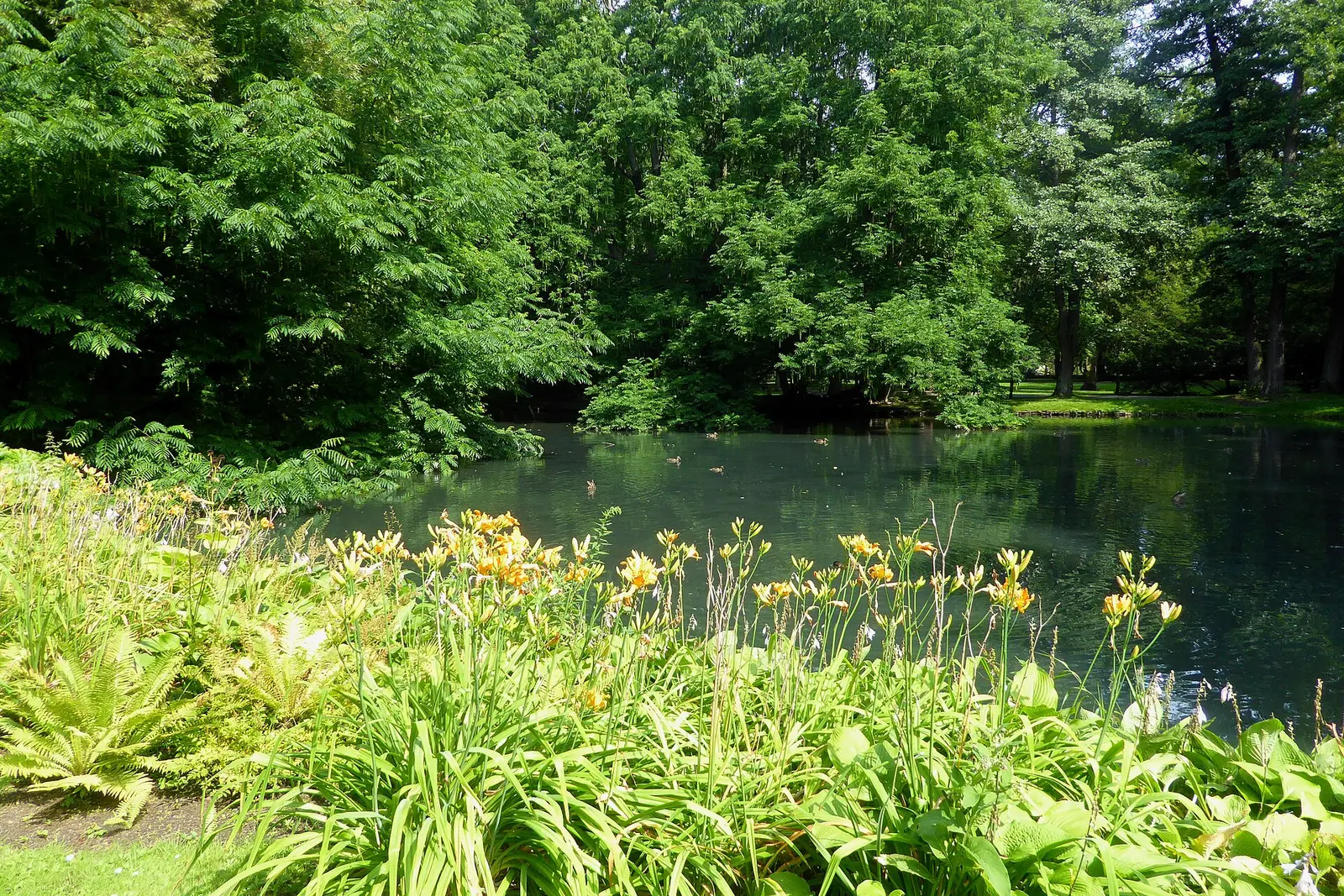

Oliwa Park, officially Adam Mickiewicz Park, was once the garden of the Cistercian abbots. Most of its present layout dates from the time of Abbot Jacek Rybiński (1740–1782), the same abbot who commissioned the great organ in the cathedral. In 1926, when Oliwa became part of Gdańsk, the garden was opened to everyone. Entry is free today. The gates open at 5:00 and close at 23:00 from May to September and at 20:00 from October to April.
Two hours is enough for an unhurried walk including the palm house. Add the cathedral and one museum and you have half a day.
The entrance and the main axis
The main gate is on Opata Jacka Rybińskiego Street, opposite Inwalidów Wojennych square. A second entrance leads in from Cystersów Street next to the cathedral, and a side exit opens onto Grunwaldzka Avenue.
From the main gate you can see how the park was designed. An axis runs from the rococo Abbots' Palace through clipped hedge avenues to the pond known as the Swan Pond. This part is geometric, in the French style: the trees are trimmed into green walls with long, narrow corridors between them. Further on, towards Grunwaldzka, the park becomes a landscape garden with winding paths, a canal and old trees.
The Palm House
You can see the glass tower of the palm house from afar. Inside is a collection of warmth-loving plants: araucarias, cycads, windmill palms and an old date palm that Oliwa has been proud of for generations. The palm house is open Tuesday to Sunday, 10:00–18:00 (last entry 17:45), and closed on Mondays. Entry is free.
In very hard frosts the city's parks department sometimes closes it for a few days to keep the temperature up for the plants, so in winter it's worth checking first.


The Whispering Grotto and the themed gardens
The Whispering Grotto, also called the Ears of Dionysius, is an 18th-century acoustic structure. Two people stand at opposite walls and can hear each other whisper despite the distance. Children can happily spend a quarter of an hour here.
The park also has a rock garden, a small Japanese garden with shaped azaleas and stone lanterns, and botanical collections. In spring, usually at the turn of April and May, the magnolias bloom and the paths get crowded. It's quietest on weekday mornings.
Ponds and the canal
The landscape part is at its best in summer and autumn. Old trees line the canal, ducks and swans swim on the water, and someone is always sitting on the bench by the cascade. The paths are flat and paved, so a pushchair or a child's scooter is no problem.
Come back along a different avenue from the one you came in on. The park isn't large, but it has several parallel paths and looks a little different each time.
Next to the park
Two branches of the National Museum stand at the edge of the garden: the Abbots' Palace with modern art and the Abbots' Granary with ethnography. Both are open until 17:00 and closed on Mondays. From the Cystersów gate it's a few dozen steps to the cathedral. If you want to catch an organ recital, check the time before you go into the park.
The park, the palace, the granary and the cathedral are all on our Old Oliwa in two hours walk, with a map and a GPX file. The zoo and the tower on Pachołek Hill are separate trips. Hours and tickets for a zoo day are in Oliwa with children. Pachołek starts a few streets from the park (Pachołek Hill and the Water Forge).